

Ahmed walked into the Egyptian embassy in Tunisia carrying his file of documents, expecting it would take minutes to get a passport for his son. The response he says he received changed the course of the months and years that followed: "You have to go back to Egypt."
Ahmed moved to Tunisia in 2021 after being detained in Egypt over his work with a human rights organisation. He tells Athar he had believed that leaving Egypt would put an end to what he was going through. Instead, he discovered that the consequences of those violations did not stop at the border. They followed him and his family.
A month after the birth of his second child in April 2023, Ahmed went to the Egyptian embassy in Tunisia with the documents required to issue his son a passport. After an hour of waiting, embassy officials refused to process the application and told him he would have to return to Egypt to get one.
He spoke to the officer in charge, he says, explaining that he and his family were planning to travel to a European country in a few months and could not go to Egypt. She took his phone number and said she would "check with Egypt," and if approval came through she would call him to submit the paperwork. She did not say which authority she would be checking with.
For a full month Ahmed waited. No one called. He went back to ask and was told "the response hasn't come." He left, returned two weeks later, and was told his application had been refused. They told him to go back to Egypt to get his son's passport. Ahmed says the refusal hit him like a thunderbolt. He had held out some hope, but on this third visit "that hope shattered." He adds: "I felt deeply let down. How do you plan a child's future without the document that would allow him to move?"

The refusal, Ahmed stresses, deprived his son of a travel document, restricting the entire family's ability to leave Tunisia. They were unable to travel to the European country where they had hoped to settle.
But Ahmed's account conflicts with what a source at the Egyptian Ministry of Foreign Affairs confirmed: that citizens have the right to obtain passports for their children through embassies. This is consistent with information published on the ministry's website, which lists passport issuance and renewal among consular services and sets out the documents required for first-time issuance, all of which Ahmed says he had.
The ministry notes that during the first third of 2026, approximately 34,000 passports were issued to Egyptians abroad, a figure that illustrates the scale of the service provided through Egyptian embassies and consulates.
Today, Ahmed's son is three and a half. Despite his young age, he has started hearing about travel from his older brother, who wants to go to Japan because of his love of anime. The younger boy now wants to go there too, Ahmed says. He has no answer to his children's questions about travel, and tries to compensate by travelling within Tunisia.
Ahmed says he does not know what the future holds. He feels he has lost his freedom of movement. "There is no future while the current situation continues, with no travel document for my son that would allow us to move from Tunisia to another country."
Freedom of movement and the right to official documents
Abdel Halim Hanish, a human rights lawyer, confirms that the Egyptian constitution and the international treaties Egypt has ratified, foremost the International Covenant on Civil and Political Rights, guarantee freedom of movement, not only within Egyptian territory, as well as the citizen's right to obtain official documents establishing their personal data.
Speaking to Athar, Hanish draws on several articles of the Egyptian constitution that guarantee citizens rights and freedoms related to movement, official documents, and the protection of Egyptians living abroad. Article 62 states that "freedom of movement, residence, and emigration is guaranteed" and that "no citizen may be expelled from the territory of the state or prevented from returning to it." Article 6 provides that legal recognition of the citizen and the granting of official documents establishing personal data "is a right guaranteed and regulated by law."
Hanish also cites Article 88, which obliges the state to protect the interests, rights, and freedoms of Egyptians residing abroad. He argues that these provisions place on the state an obligation to protect the rights of its citizens abroad, not to use consular procedures as a means of diminishing them. He further cites Article 92, which states that rights and freedoms inherent to the citizen may not be suspended or diminished, and that any law regulating the exercise of these rights must not restrict them in a way that affects their essence.
He also points to Article 53, which establishes equality among citizens in rights, freedoms, and public duties, and prohibits discrimination on any basis including political affiliation. Taken together, Hanish argues, these constitutional provisions create a framework protecting Egyptian citizens, including those living abroad, from being deprived of their fundamental rights or having them restricted without clear legal basis.
Hanish cites Article 12 of the ICCPR, which guarantees every person lawfully within the territory of a state freedom of movement and choice of residence, and the right to leave any country including their own. These rights may only be restricted by provisions set out in law that are necessary to protect national security, public order, public health, public morals, or the rights and freedoms of others, and that are consistent with the other rights recognised in the Covenant.
He also references Civil Status Law No. 143 of 1994, which regulates the competencies of Egyptian consulates abroad regarding civil registry records, receiving applications for national ID cards and replacements, and processing changes or renewals.
Under this law, Hanish explains, Egyptian citizens residing abroad are required to report births and deaths. The law's executive regulations set out the procedures for reporting, registration, and the rules governing these transactions within Egyptian consulates.
He notes that the Passport Law No. 97 of 1959, and its amendments, regulates Egyptians' right to obtain passports and the authorities responsible for issuing and renewing them. Article 7 provides that passports shall be issued to persons holding Egyptian nationality, whether established by origin or by a nationality certificate issued by the Ministry of Interior.
Article 10, Hanish explains, defines the responsibilities for passport issuance and renewal: the Ministry of Foreign Affairs handles diplomatic, special, and mission passports, while the Ministry of Interior and Egyptian consulates abroad handle ordinary passports.
This means, he adds, that Egyptian consulates are not separate from the passport issuance system. The law assigns them the authority to issue and renew ordinary passports for Egyptians outside the country.
Obstructing fundamental rights
In a report published on 13 March 2023, Human Rights Watch documented Egyptian authorities' refusal, through their embassies, to issue or renew identity documents for dozens of dissidents, journalists, and human rights activists living abroad.
The report was based on interviews with 26 Egyptian dissidents, journalists, and lawyers living in Turkey, Germany, Malaysia, an African country, Qatar, and another Gulf state, conducted from June to December 2022, along with a review of dozens of documents. The organisation said that the inability to obtain birth certificates or renew essential documents such as passports and identity cards had obstructed the fundamental rights of dissidents abroad and their dependants, effectively undermining their ability to travel, live, and work legally, and in some cases threatening their access to basic healthcare, education, and family reunification.
Adam Coogle, deputy director of HRW's Middle East and North Africa division, accused the Egyptian government of exporting what he called "repression" through its embassies and consulates abroad, aimed at "destroying the livelihoods of Egyptians in exile."
Ahmed Rabie (a pseudonym), a young Egyptian living in Turkey, says the Egyptian consulate in Istanbul refused to renew his passport in 2019 and told him it could only issue a travel document enabling him to return to Egypt.
Selim Mamdouh (a pseudonym) also received a refusal from the Egyptian consulate in Marseille when he tried to obtain official documents for himself, his wife, and his daughter. He tells Athar that in early 2025 he was preparing a family reunification application to bring his wife and daughter from Egypt to France and needed birth certificates for all three to include with the application.
Selim says he did not go to the consulate in person because he is an asylum seeker. He authorised a French lawyer to obtain the certificates on his behalf, but the consulate refused and told the lawyer that Selim would have to appear in person.
Egyptians abroad can obtain official identity documents through consular services provided by Egyptian embassies and consulates, either in person or through a representative authorised by an official power of attorney, in accordance with applicable procedures. Official communications from Egyptian embassies and consulates on Facebook outline the procedures for obtaining and collecting certain documents, which may be done by the applicant or an authorised representative.
Because of this refusal, Selim says, he asked his wife in Cairo to obtain the documents, have them translated and certified, and send them to him, delaying the reunification process for the family he was trying to bring to France.
Article 17 of the ICCPR states that "no one shall be subjected to arbitrary or unlawful interference with his privacy, family, home or correspondence." Under Article 5 of the Vienna Convention on Consular Relations (1963), consular functions include protecting the interests and nationals of the sending state, granting passports and travel documents to nationals of the sending state, and authenticating documents.
Hanish, the human rights lawyer, says the importance of identity documents goes beyond their administrative function. For children in particular, they are tied to identity itself, while travel documents determine their ability to move beyond their country of residence.
He cites Article 3 of the Convention on the Rights of the Child, which provides that in all actions concerning children, the best interests of the child shall be a primary consideration. Article 7 states that a child shall be registered immediately after birth and shall have the right from birth to a name, the right to acquire a nationality, and as far as possible the right to know and be cared for by their parents.
Under Article 8 of the Convention, states parties undertake to respect the right of the child to preserve their identity, including nationality, name, and family relations. If a child is illegally deprived of some or all elements of their identity, states parties shall provide appropriate assistance and protection "with a view to re-establishing speedily his or her identity," Hanish says.
Transnational repression
Basma Mostafa, programme director at the Law and Democracy Support Foundation based in Berlin, says the organisation has documented numerous cases of transnational repression over the past three years, involving various methods including the obstruction or freezing of official document issuance from consulates for dissidents and human rights defenders.
Speaking to Athar, Basma says transnational repression carries a clear political message: that exile does not necessarily provide protection, and that geographic distance is no barrier to security pressure and deterrence. Criticising the state from abroad may be met with punishment or retaliation in different forms, even if the methods differ from those used domestically.
Human Rights Watch defines transnational repression as the use by government entities of their influence beyond their borders to suppress or silence dissent, by targeting human rights defenders, journalists, government critics, dissidents, and others in ways that violate their rights. The organisation notes that the term does not yet have a formal legal definition.
During the review of Egypt's human rights record by the UN Human Rights Council's Universal Periodic Review working group in early 2025, the Egyptian Human Rights Forum (EHRF) submitted a report addressing the suspension of official identity documents and denial of consular services for Egyptians abroad.
The report noted that in countries that have attracted large segments of the Egyptian political opposition, such as Turkey, official identity documents are issued only after a prior security screening. It confirmed that in practice, most identity document applications from citizens residing in Turkey are arbitrarily rejected simply because of the large dissident community there, with non-political citizens affected as a consequence.
According to the report, defenders and dissidents face the same obstruction when trying to obtain documents for their children, particularly birth certificates. Without a birth certificate, a child has no legal personality and lives in a grey zone. Technically, the absence of a birth certificate from the country of origin means the child has no nationality, making it impossible to obtain citizenship in the host country. This creates profound uncertainty for citizens and their children's futures, producing a class of stateless people. Without personal identity documents and other necessary papers, the residency and legal status of defenders in host countries is under constant threat, particularly for those who do not intend to seek dual citizenship.
Also during the UPR, the Committee for Justice (CFJ), an independent association dedicated to defending human rights, submitted a report noting that Egyptian authorities use diplomatic missions as instruments of repression. Egyptian embassies and consulates, it said, routinely refuse to issue, renew, or process essential documents for human rights defenders, journalists, political activists, and those perceived as critics.
In these cases, according to the CFJ report, consular officials typically inform applicants that the request was refused due to the absence of security clearance, without providing a legal justification, a written decision, or a means of appeal. The committee views this practice as an extraterritorial extension of domestic security control mechanisms, operating entirely outside transparent administrative or judicial procedures.
The CFJ states that as a result, "those affected are deprived of any effective means of challenging the denial of documents." For human rights defenders in exile, this creates a state of prolonged legal insecurity that directly affects the exercise of fundamental rights, including the right to family life, legal identity, work, education, and freedom of movement.
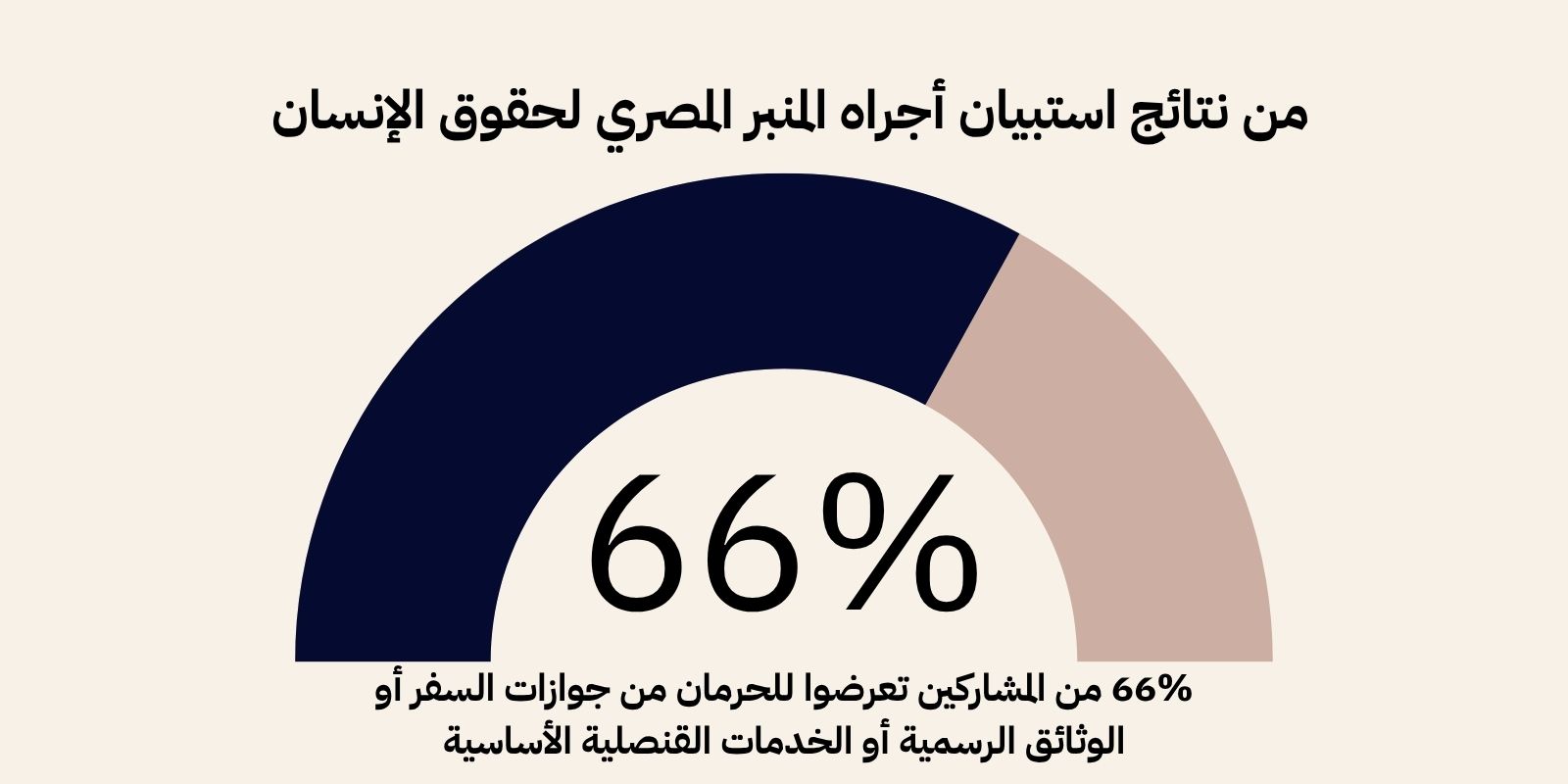
In February 2026, the Egyptian Human Rights Forum published a report titled "Wherever They Go: Transnational Repression and the Targeting of Egyptians Abroad," revealing that approximately 66% of respondents to a survey reported being denied passports, official documents, or basic consular services.
Samar El-Husseini, executive director of the Egyptian Human Rights Forum, says the crisis, though it appears on the surface to be a simple bureaucratic matter, is in reality one of the structural crises and systematic practices the Egyptian state uses against Egyptians abroad as a form of punishment and targeting.
Speaking to Athar, she explains that the consequences of this practice amount to what looks like "bureaucratic citizenship stripping." No official decision is issued revoking a person's nationality. Instead, the rights and benefits attached to it are gradually withdrawn: obtaining an ID card, renewing a passport, registering births and children, documenting marriages and divorces, issuing powers of attorney to lawyers, and completing the consular transactions that allow a person to manage their property in Egypt.
In some cases, she says, the situation extends to the inability to obtain inheritance declarations in Egypt because a family member abroad cannot obtain the necessary consular documents.
The consequences, El-Husseini says, do not stop at personal and legal transactions. They extend to professional life as well. Some occupations require a security background check or a criminal record certificate. If the embassy refuses to issue these documents, the person cannot complete their paperwork, affecting their ability to work.
She views the intervention of Egyptian authorities, represented by the security services and the Ministry of Interior, in these consular procedures as one of the most blatant practices of transnational repression, used systematically across a number of Egyptian embassies, despite the fact that these should be simple bureaucratic procedures linked to citizenship rights.
The problem goes beyond embassies refusing to issue documents. There is a related practice, she says, of placing a "block" in civil registry records, preventing family members inside Egypt from obtaining documents on the person's behalf. The consequences can extend to the non-registration of children born in countries such as the Gulf states and Turkey, potentially placing these children in an extremely precarious legal position and depriving them of proof of identity or nationality.
El-Husseini notes that women may face even more complex consequences in personal status matters. Some women may be forced to remain in marriages where they experience violence or abuse because they cannot obtain an official divorce document. A man, even while his registered marriage continues, can marry again under the rules that apply to him. A woman, without an official divorce document, remains legally married. If she marries on the basis of an undocumented divorce, she may face serious legal consequences.
She says the severity of this practice does not receive sufficient attention because some treat it as merely a problem of not getting paperwork. But its effects extend to fundamental rights: "not getting your official documents" can mean, in some cases, being unable to register, educate, or obtain healthcare for your children, along with other legal and social consequences.
El-Husseini argues that the Egyptian authorities, along with the National Council for Human Rights and the Egyptian parliament, should review this practice and hold those responsible to account. Documenting the cases, she says, could reveal one of the most egregious violations of the rights of Egyptians abroad. She adds that this practice, in her view, "is not only illegal but unconstitutional," given that citizenship rights are guaranteed in the Egyptian constitution.
She notes that the National Council for Human Rights proposed last year forming a committee to examine the situation of Egyptians abroad, particularly issues related to identity documents. But with changes in the council's composition and direction, and a decline in cooperation with independent organisations, no practical steps have been taken to resolve the problem.
In this context, it is worth noting that Egypt's Supreme Constitutional Court ruled, in a judgment issued on 4 November 2000 and published in the Official Gazette on 16 November of the same year, in Case No. 243 of Judicial Year 21, that Articles 8 and 11 of the Passport Law were unconstitutional. These articles had delegated to the Minister of Interior the authority to set conditions for granting passports and the power to refuse issuance or renewal, as well as to revoke a passport after it had been granted, for "important reasons at his discretion." The court held that this formulation "amounts to the legislator's abdication of establishing the general principles governing the entire subject of passports, despite their being the sole means of enabling a citizen to leave and return to their country, and the close connection of this to the rights guaranteed by the constitution."
In its ruling, the court affirmed the citizen's right to obtain and carry a passport as a marker of their Egyptian identity, which they bear with pride at home and abroad, and as a component of the personal freedom guaranteed and protected by the constitution. The ruling established that freedom of movement ranks among public freedoms, and that restricting it without legitimate cause strips personal freedom of some of its essential characteristics.
Finally, while the Ministry of Foreign Affairs affirms that passport issuance and renewal, birth certificate processing, and other basic consular services are available to Egyptians abroad, the experiences of Ahmed and Selim, along with what human rights reports have documented, indicate that Egyptians abroad face difficulty accessing official documents because of their political positions toward the current authorities.